Contextual Dimension
 Contextual
Learning objective
By the end of this page you'll be able to configure all four Contextual-dimension factors, understand why they're entered as a single national number rather than a spatial dataset, and know which published index backs each one.
The Contextual Dimension refers to the laws and policies that shape workplace gender discrimination, financial autonomy, and overall gender empowerment. Although this dimension may vary between countries due to differences in legal frameworks, it remains consistent within a single country, as national policies and regulations are typically applied uniformly across countries. For more information on data input used from open sources, see the Getting Data tutorial.
Every Contextual factor uses the National Index Score technique (see Processor Types): a researched national score typed straight into the factor's dialog, no spatial dataset involved. Configure each one using the pattern from Configuring Items: double-click, enter the score, then right-click → Run Item Workflow. See Getting Data for how that number is calculated and entered.
Input Contextual factors
 Generic analysis: the EPLEX score
EPLEX is a summary measure of Employment Protection Legislation (EPL) stringency, created by the International Labour Organization (ILO), that measures how strongly a country's laws protect workers against dismissal at the initiative of an employer.
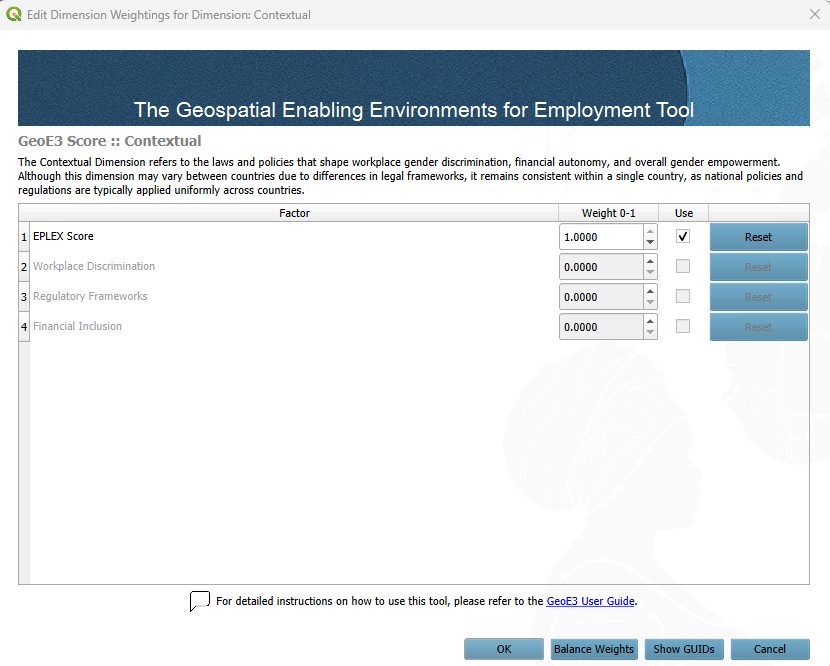
Enter the EPLEX score as a fraction between 0 and 1 (the tool multiplies it by 5 to put it on the usual 0–5 scale); if you already have a value on the 0–5 scale from an older project, you can enter that directly and it's used as-is.
Women's Enabling Environments analysis: the WBL database
For a Women's Enabling Environments analysis, GeoE3 uses data from the WBL (Women, Business and the Law) database instead:
 Workplace Discrimination involves laws that address gender biases
and stereotypes that hinder women's career advancement, especially in
male-dominated fields. It's obtained from the Workplace Index score of
the WBL.
 Regulatory Frameworks pertain to laws and policies that protect
women's employment rights, such as childcare support and parental
leave, influencing their workforce participation. This indicator is
composed by the Pay and Parenthood Index score of the WBL database.
 Financial Inclusion involves laws concerning women's access to
financial resources like loans and credit, which is crucial for
starting businesses and investing in economic opportunities. This
indicator is composed by the Entrepreneurship Index score of the WBL
2024.
The WBL index scores are already 0–100, so you enter the published value directly and GeoE3 converts it to the usual 0–5 scale for you:
| WBL score | GeoE3 score | Colour |
|---|---|---|
| 95 – 100 | 5 | |
| 90 – 94 | 4 | |
| 80 – 89 | 3 | |
| 75 – 79 | 2 | |
| 60 – 74 | 1 | |
| 0 – 59 | 0 |
As a rough feel for the scale: a country with strongly enabling legislation would score in the 90s; something clearly below that reflects whatever gap you've identified in your research.
Default scores by country
If you'd rather skip the lookup entirely, the table below gives the Workplace Discrimination, Regulatory Frameworks (average of the WBL Pay and Parenthood scores) and Financial Inclusion score for every country WBL covers, straight from the WBL 2024 report year (data current as of October 1, 2023). WBL adds and revises countries each year; if you need a different (later) report year, or a country that isn't listed below, look it up directly at wbl.worldbank.org.
| Economy | Workplace Discrimination | Regulatory Frameworks | Financial Inclusion |
|---|---|---|---|
| Afghanistan | 50 | 10 | 75 |
| Albania | 100 | 90 | 100 |
| Algeria | 75 | 55 | 75 |
| Angola | 100 | 55 | 100 |
| Antigua and Barbuda | 50 | 47.5 | 75 |
| Argentina | 75 | 55 | 75 |
| Armenia | 75 | 87.5 | 75 |
| Australia | 100 | 100 | 100 |
| Austria | 100 | 100 | 100 |
| Azerbaijan | 100 | 65 | 100 |
| Bahamas, The | 100 | 47.5 | 75 |
| Bahrain | 75 | 70 | 100 |
| Bangladesh | 50 | 22.5 | 75 |
| Barbados | 100 | 45 | 75 |
| Belarus | 50 | 65 | 75 |
| Belgium | 100 | 100 | 100 |
| Belize | 75 | 55 | 75 |
| Benin | 100 | 67.5 | 100 |
| Bhutan | 100 | 70 | 75 |
| Bolivia | 75 | 80 | 100 |
| Bosnia and Herzegovina | 100 | 65 | 100 |
| Botswana | 25 | 37.5 | 75 |
| Brazil | 100 | 77.5 | 75 |
| Brunei Darussalam | 25 | 37.5 | 75 |
| Bulgaria | 100 | 100 | 100 |
| Burkina Faso | 100 | 52.5 | 100 |
| Burundi | 100 | 70 | 75 |
| Cabo Verde | 100 | 57.5 | 100 |
| Cambodia | 100 | 47.5 | 100 |
| Cameroon | 75 | 52.5 | 50 |
| Canada | 100 | 100 | 100 |
| Central African Republic | 100 | 45 | 75 |
| Chad | 75 | 55 | 50 |
| Chile | 75 | 87.5 | 75 |
| China | 100 | 62.5 | 75 |
| Colombia | 100 | 75 | 75 |
| Comoros | 75 | 70 | 75 |
| Congo, Dem. Rep. | 100 | 65 | 100 |
| Congo, Rep. | 75 | 22.5 | 75 |
| Costa Rica | 100 | 80 | 75 |
| Croatia | 100 | 100 | 100 |
| Cyprus | 100 | 87.5 | 100 |
| Czechia | 100 | 100 | 100 |
| Côte d'Ivoire | 100 | 90 | 100 |
| Denmark | 100 | 100 | 100 |
| Djibouti | 100 | 55 | 100 |
| Dominica | 25 | 25 | 75 |
| Dominican Republic | 100 | 67.5 | 100 |
| Ecuador | 100 | 70 | 75 |
| Egypt, Arab Rep. | 75 | 10 | 100 |
| El Salvador | 100 | 77.5 | 100 |
| Equatorial Guinea | 75 | 80 | 0 |
| Eritrea | 100 | 47.5 | 75 |
| Estonia | 100 | 100 | 100 |
| Eswatini | 25 | 35 | 0 |
| Ethiopia | 100 | 42.5 | 100 |
| Fiji | 100 | 55 | 75 |
| Finland | 100 | 90 | 100 |
| France | 100 | 100 | 100 |
| Gabon | 100 | 90 | 100 |
| Gambia, The | 50 | 67.5 | 75 |
| Georgia | 100 | 77.5 | 100 |
| Germany | 100 | 100 | 100 |
| Ghana | 100 | 35 | 75 |
| Greece | 100 | 100 | 100 |
| Grenada | 50 | 60 | 75 |
| Guatemala | 25 | 55 | 75 |
| Guinea | 100 | 35 | 100 |
| Guinea-Bissau | 25 | 47.5 | 25 |
| Guyana | 100 | 70 | 100 |
| Haiti | 50 | 70 | 75 |
| Honduras | 100 | 35 | 100 |
| Hong Kong SAR, China | 100 | 67.5 | 100 |
| Hungary | 75 | 87.5 | 100 |
| Iceland | 100 | 100 | 100 |
| India | 100 | 32.5 | 75 |
| Indonesia | 100 | 57.5 | 75 |
| Iran, Islamic Rep. | 0 | 55 | 75 |
| Iraq | 100 | 35 | 100 |
| Ireland | 100 | 100 | 100 |
| Israel | 100 | 55 | 100 |
| Italy | 100 | 100 | 100 |
| Jamaica | 75 | 35 | 75 |
| Japan | 50 | 62.5 | 75 |
| Jordan | 75 | 70 | 100 |
| Kazakhstan | 50 | 77.5 | 75 |
| Kenya | 100 | 70 | 75 |
| Kiribati | 100 | 60 | 75 |
| Korea, Rep. | 100 | 52.5 | 100 |
| Kosovo | 100 | 80 | 100 |
| Kuwait | 75 | 0 | 75 |
| Kyrgyz Republic | 100 | 32.5 | 100 |
| Lao PDR | 75 | 67.5 | 100 |
| Latvia | 100 | 100 | 100 |
| Lebanon | 100 | 35 | 75 |
| Lesotho | 75 | 47.5 | 75 |
| Liberia | 100 | 60 | 75 |
| Libya | 50 | 57.5 | 75 |
| Lithuania | 100 | 100 | 100 |
| Luxembourg | 100 | 100 | 100 |
| Madagascar | 100 | 32.5 | 75 |
| Malawi | 100 | 70 | 75 |
| Malaysia | 50 | 67.5 | 75 |
| Maldives | 100 | 57.5 | 100 |
| Mali | 50 | 55 | 75 |
| Malta | 100 | 77.5 | 100 |
| Marshall Islands | 50 | 50 | 100 |
| Mauritania | 25 | 42.5 | 75 |
| Mauritius | 100 | 80 | 100 |
| Mexico | 100 | 67.5 | 100 |
| Micronesia, Fed. Sts. | 25 | 37.5 | 75 |
| Moldova | 100 | 100 | 100 |
| Mongolia | 100 | 100 | 100 |
| Montenegro | 100 | 65 | 100 |
| Morocco | 100 | 65 | 100 |
| Mozambique | 100 | 55 | 100 |
| Myanmar | 25 | 55 | 75 |
| Namibia | 75 | 57.5 | 75 |
| Nepal | 100 | 70 | 75 |
| Netherlands | 100 | 100 | 100 |
| New Zealand | 100 | 90 | 100 |
| Nicaragua | 100 | 57.5 | 100 |
| Niger | 75 | 55 | 50 |
| Nigeria | 75 | 25 | 75 |
| North Macedonia | 100 | 65 | 100 |
| Norway | 100 | 100 | 75 |
| Oman | 50 | 55 | 75 |
| Pakistan | 100 | 35 | 75 |
| Palau | 25 | 37.5 | 75 |
| Panama | 100 | 65 | 75 |
| Papua New Guinea | 50 | 12.5 | 75 |
| Paraguay | 100 | 90 | 100 |
| Peru | 100 | 90 | 100 |
| Philippines | 100 | 80 | 100 |
| Poland | 100 | 100 | 100 |
| Portugal | 100 | 100 | 100 |
| Puerto Rico | 100 | 47.5 | 100 |
| Qatar | 0 | 25 | 75 |
| Romania | 100 | 100 | 100 |
| Russian Federation | 50 | 65 | 75 |
| Rwanda | 100 | 80 | 100 |
| Samoa | 100 | 57.5 | 75 |
| San Marino | 50 | 87.5 | 75 |
| Saudi Arabia | 100 | 70 | 100 |
| Senegal | 100 | 65 | 75 |
| Serbia | 100 | 100 | 100 |
| Seychelles | 50 | 77.5 | 75 |
| Sierra Leone | 100 | 80 | 100 |
| Singapore | 75 | 67.5 | 75 |
| Slovak Republic | 100 | 87.5 | 100 |
| Slovenia | 100 | 87.5 | 100 |
| Solomon Islands | 25 | 12.5 | 75 |
| Somalia | 50 | 45 | 75 |
| South Africa | 100 | 90 | 100 |
| South Sudan | 100 | 70 | 75 |
| Spain | 100 | 100 | 100 |
| Sri Lanka | 75 | 22.5 | 75 |
| St. Kitts and Nevis | 25 | 45 | 75 |
| St. Lucia | 100 | 70 | 75 |
| St. Vincent and the Grenadines | 25 | 35 | 75 |
| Sudan | 0 | 10 | 75 |
| Suriname | 100 | 67.5 | 50 |
| Sweden | 100 | 100 | 100 |
| Switzerland | 100 | 90 | 75 |
| Syrian Arab Republic | 25 | 20 | 75 |
| São Tomé and Príncipe | 100 | 67.5 | 75 |
| Taiwan, China | 100 | 90 | 75 |
| Tajikistan | 50 | 65 | 100 |
| Tanzania | 100 | 80 | 75 |
| Thailand | 100 | 47.5 | 75 |
| Timor-Leste | 75 | 80 | 75 |
| Togo | 100 | 90 | 100 |
| Tonga | 25 | 37.5 | 75 |
| Trinidad and Tobago | 50 | 47.5 | 100 |
| Tunisia | 75 | 32.5 | 75 |
| Türkiye | 100 | 77.5 | 75 |
| Uganda | 100 | 70 | 75 |
| Ukraine | 100 | 40 | 100 |
| United Arab Emirates | 100 | 80 | 100 |
| United Kingdom | 100 | 90 | 100 |
| United States | 100 | 77.5 | 100 |
| Uruguay | 100 | 77.5 | 75 |
| Uzbekistan | 50 | 80 | 100 |
| Vanuatu | 25 | 25 | 100 |
| Venezuela, RB | 100 | 77.5 | 75 |
| Viet Nam | 100 | 90 | 100 |
| West Bank and Gaza | 25 | 0 | 75 |
| Yemen, Rep. | 25 | 12.5 | 75 |
| Zambia | 100 | 70 | 100 |
| Zimbabwe | 100 | 57.5 | 100 |
Citation: World Bank. 2024. Women, Business and the Law 2024. Washington, DC: World Bank. Topic-level scores (Workplace, Pay, Parenthood, Entrepreneurship) drawn from the WBL 2024 historical panel dataset: WBL2024-1-0-Historical-Panel-Data.xlsx, available from the WBL download data page.
Note
WBL restructured its methodology starting with the 2026 report ("WBL 2.0"), scoring three pillars (legal frameworks, supportive frameworks, enforcement perceptions) per topic instead of one flat score. The topic-level scores this table uses are only published under the earlier ("1.0") methodology, which is why this table is pinned to the 2024 report year rather than the latest one.
Once every factor has a value, double-click the Contextual dimension and follow the same generic pattern as every other item in the tree: assign weights, balance them, and run it.
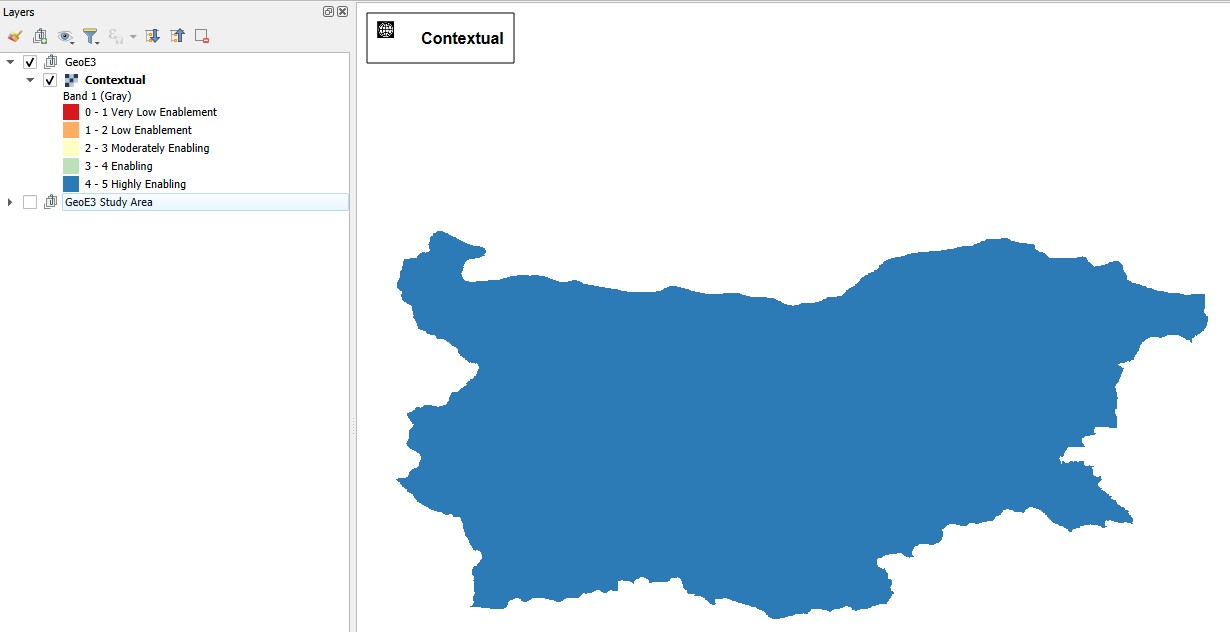
The outputs (Workplace Discrimination, Regulatory Frameworks and Financial Inclusion, plus their aggregation into the final Contextual score) land in the Contextual folder within your project folder, on the usual 0–5 enablement scale.
Recap
- All four Contextual factors (EPLEX Score for a generic analysis; Workplace Discrimination, Regulatory Frameworks and Financial Inclusion for a Women's Enabling Environments analysis) are entered as a single national number, not a spatial dataset.
- Workplace Discrimination, Regulatory Frameworks and Financial Inclusion map to three different WBL 2024 sub-indices (the Workplace, Pay and Parenthood, and Entrepreneurship index scores respectively). Don't reuse the same number for all three.
- Results combine into a single Contextual output on the usual 0–5 enablement scale, viewable as a mutually-exclusive layer group.