
3.5 World Bank Group Metadata Standards by Data Type
This section outlines the metadata standards chosen by the WBG Chief Statistician and formally implemented by the Bank for documenting development data and associated resources. For a detailed description of each standard, consult the online documentation of the standards.[1] For guidance on their use and a description of the elements they contain, refer to the Metadata Editor User Guide,[2] which also serves as a reference guide for data curators.
3.5.1 Microdata
Microdata refers to electronic datasets that contain detailed observations at the unit level, including individuals, households, facilities, or enterprises. These datasets are commonly presented in tabular format, with rows corresponding to observational units and columns representing variables. A micro-dataset may comprise multiple related files, which can exhibit hierarchical relationships (such as a household file linked to individual-level files). Microdata is typically sourced from surveys, censuses, administrative records, transactional databases, or sensors.
The Bank has adopted the Data Documentation Initiative (DDI) metadata standard—created and maintained by the DDI Alliance under the GNU General Public License—for microdata documentation.[3] The DDI standard is extensively implemented by data archives, national statistical authorities, and international organizations to facilitate systematic preservation, distribution, and reuse of microdata.
The DDI standard has two main branches: LifeCycle and Codebook. The Bank uses DDI Codebook (version 2.5 or above) to manage, present, exchange, and preserve metadata in social and behavioral sciences. Metadata is organized into five sections:
Document Description – Metadata about the documentation itself, like creation date, version, authorship, and cataloging information.
Study Description – Information about the study, including title, producer or principal investigator, objectives, data version, sampling design, geographic and temporal coverage, and thematic topics.
Data Files Description – A concise description of each data file included in the dataset.
Variables Description – Detailed information on each variable, such as names and labels, value categories, formats and types, interviewer notes, and summary statistics.
Variables Groups – Virtual organization of variables into thematic or other groups. This is optional and not systematically implemented, but adds value for data discovery.
To improve usability and consistency throughout the Bank’s metadata systems, several cross-cutting sections have been added to complement the standard, such as “Additional,” “Provenance,” “Tags,” “DataCite,” and “Administrative metadata.”
File- and variable-level sections create a data dictionary, which is essential structural metadata for microdata assets. Building these manually is time-consuming, but the Bank’s metadata editor simplifies the process by importing datasets from formats like Stata or SPSS and automatically extracting file names, variable details, labels, and summary statistics from the data files. Curators can then add more information, such as question text or skip patterns.
3.5.2 Indicators and Databases of Indicators
Two distinct metadata standards are implemented for documenting indicators and their associated databases. The first standard is designed to document each indicator individually, while the second standard pertains to the documentation of databases or datasets containing collections of indicators.
Indicators
Indicators are summary measures related to key issues or phenomena, derived (and possibly modelled) from observed facts. Indicators form time series when they are provided for a specific geography and with a temporal ordering, i.e. when their values are provided with an ordered annual, quarterly, monthly, daily, or other time reference.
The Bank developed a bespoke metadata standard for documenting indicators by consolidating and structuring metadata elements utilized by various organizations, including the Bank itself, United Nations agencies, the International Monetary Fund (IMF), the Organisation for Economic Co-operation and Development (OECD), and others. The standard includes elements such as a unique identifier, label, definition, methodology information, details about the data producer and source, geographic and temporal coverage, a list of relevant keywords or topics, and information on known data limitations, among others.
The standard is compatible with the Statistical Data and Metadata Exchange (SDMX) framework. SDMX serves as a data exchange protocol designed to streamline machine-to-machine transfers. It offers a methodology for organizing metadata via Metadata Structure Definitions (MSDs), while not governing MSD content. Accordingly, the Bank’s metadata standard augments and integrates seamlessly within the SDMX environment. Metadata templates developed by the Bank may be exported as MSDs, and metadata describing indicators may be presented as meta-datasets. This approach allows descriptive and reference metadata produced by the Bank to be incorporated into systems that comply with SDMX-based data management and dissemination requirements.
The indicator metadata must also include structural metadata that describes how the data are stored and organized in data files. Structural metadata is closely linked to data modeling which establishes both the logical and physical architecture of data by defining entity relationships, associated attributes, and integrity rules.[4] This form of metadata transposes the data model into a machine-readable format, thereby facilitating accurate processing and interpretation by information systems. Clearly articulating the data model and structure is critical for effective data dissemination through APIs. APIs (Application Programming Interfaces) enable standardized requests and exchanges of data between systems.
The Bank metadata standard for documenting indicators has a designated section for outlining an indicator's data structure (Figure 11). This structure follows the SDMX Data Structure Definition (DSD) and is based on the assumption that data are kept in a tabular long format.
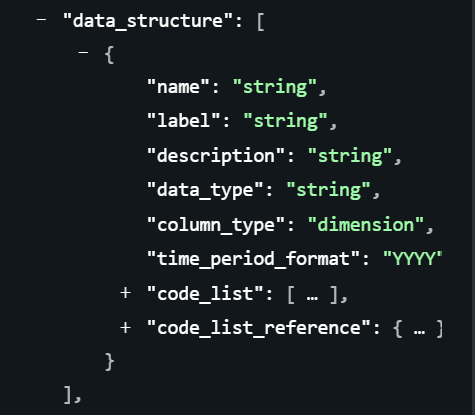
Figure 11 - Data structure definition
A crucial part of describing data structures is specifying the column_type metadata element. This element defines the function of each column in a long-format data file and includes options such as:
Indicator ID: The indicator unique identifier.
Indicator name: Holds the main title or name of an indicator; there should be only one primary name (alternative names may be documented as aliases in the indicator metadata).
Geography: Identifies the geographical area for each value, typically holding a geographic code, with corresponding names available in a code list or an attribute-type column.
Time period: Specifies the time frame, like year, quarter, or month, applicable to each observation.
Dimension: Used for additional breakdowns of an indicator, with one or several columns serving as dimensions—or potentially none at all. When combined with indicator ID, geography, and time period, these create unique identifiers for each observation. Dimensions typically use code lists to list possible values.
Periodicity: The column indicates the (optional) periodicity of the indicator. Periodicity refers to the frequency or time interval at which data is collected, reported, or made available in a dataset. In the context of a Data Structure Definition (DSD), periodicity indicates how often the data for a particular observation is updated or recorded. SDMX provides a standard code list for periodicities.
Attribute: An attribute is information associated with the data that describes a specific characteristic or property of the observation value but is not a geography or dimension. Attributes can have code lists associated with them.
Observation value: The observation value. An indicator must have one and only one column identified as containing the information value (when data are stored in long format).
Annotation: The column contains an annotation for the indicator. An indicator can have more than one annotation. An annotation is a piece of supplementary information or metadata that provides additional context or clarification about specific data or structures within the DSD. Annotations are typically used to provide non-technical explanations, clarifications, or other details that help users understand or interpret the data or metadata more accurately.
Let’s consider an indicator "Population by Sex (Thousands)", which provides the population of Belgium for years 2010 and 2020 disaggregated by sex (male/female/total) and is stored as follows in the data file.
| ID | Indicator | Country_code | Country_name | Year | Sex | Population | Source | Note |
|---|---|---|---|---|---|---|---|---|
| POP_SX | Population by sex | BEL | Belgium | 2010 | M | 5312221 | Census 2010 | Statbel |
| POP_SX | Population by sex | BEL | Belgium | 2010 | F | 5527684 | Census 2010 | Statbel |
| POP_SX | Population by sex | BEL | Belgium | 2010 | T | 10839905 | Census 2010 | Statbel |
| POP_SX | Population by sex | BEL | Belgium | 2020 | M | 5660064 | Census 2020 | Statbel |
| POP_SX | Population by sex | BEL | Belgium | 2020 | F | 5832577 | Census 2020 | Statbel |
| POP_SX | Population by sex | BEL | Belgium | 2020 | T | 11492641 | Census 2020 | Statbel |
The data structure definition for this indicator would be defined as follows using the data structure definition of the metadata standard:
| Column name in the data file | Information entered in the data structure definition |
|---|---|
| ID | Label: Indicator ID Description: Unique identifier of the indicator Data type: String Column type: Indicator ID |
| Indicator | Label: Indicator name Description: Title of the indicator Data type: String Column type: Indicator name |
| Country_code | Label: Country code Description: ISO country code Data type: String Column type: Geography ; Codelist: BEL = Belgium |
| Country_name | Label: Country name Description: Country name Data type: String Column type: Attribute |
| Year | Label: Year Description: Year Data type: Date Column type: Time period Time period format: YYYY |
| Sex | Label: Sex Description: Sex Data type: String Column type: Dimension ; Codelist: F = Female, M = Male, T = Total |
| Population | Label: Population Description: Resident population, mid-year Data type: Integer Column type: Observation value |
| Source | Label: Data source Description: Source of the data Data type: String Column type: Attribute |
| Note | Label: Note Description: Additional note Data type: String Column type: Annotation |
Databases of Indicators
Indicators are typically organized and maintained within databases that aggregate multiple indicators, such as the World Bank’s World Development Indicators. To facilitate this, the World Bank has established a customized metadata standard designed to describe each database or dataset associated with individual indicators. A component of this indicator metadata standard records the unique identifier for each database, thereby ensuring a clear link between an indicator and its relevant database(s).
3.5.3 Geographic Datasets and Services
Geographic datasets comprise data that specify and depict geographic locations, boundaries, and the physical or administrative attributes of features found on the Earth's surface. These datasets incorporate explicit geographic coordinates, such as latitude and longitude, alongside attribute information associated with particular spatial entities. Geographic datasets can consist of vector data, which model features as points, lines, or polygons organized into thematic layers, as well as raster data, which illustrate continuous phenomena or imagery through a grid of pixels, including sources like satellite and remote sensing imagery.
Geographic data services refer to the technologies employed for accessing, analyzing, and distributing geographic information. These services are commonly provided via interactive, web-based platforms.
The ISO Technical Committee on Geographic Information/Geomatics (ISO/TC 211) has created several metadata standards to help make geospatial datasets and services easier to find, use together, and understand. These include standards like ISO 19115-1 for describing vector geographic datasets, ISO 19115-2 for raster data, ISO 19110 for detailing feature-level characteristics, and ISO 19119 for geographic data services. Together, these are known as the ISO 19100 series. They serve as a foundation for major global geospatial metadata efforts, including those by the Open Geospatial Consortium (OGC), the U.S. Federal Geographic Data Committee (FGDC), the European INSPIRE Directive, the U.K.'s GEMINI profile, and, more recently, the Research Data Alliance (RDA).
Due to the comprehensive and intricate nature of ISO 19100, the Bank uses a streamlined implementation profile to document its geographic datasets and services. This approach maintains consistency with ISO standards, ensuring that metadata generated within the Bank's systems can be exported as ISO-compliant records whenever external users or platforms need them.
To promote consistency in the Bank’s metadata standards and improve feature descriptions, several new metadata elements have been added beyond those in ISO 19100. These additions were thoughtfully developed to maintain ISO compatibility, providing greater functionality while supporting interoperability with metadata standards used for other data types.
Core metadata elements included in ISO 19115 encompass the dataset title, unique identifier, originator and data source, geographic and temporal extent, data type, as well as the purpose or context of the dataset. For vector datasets, feature-level descriptions—addressed primarily by ISO 19110—are critical for both data discovery and usability; in contrast, for raster datasets, it is essential that metadata records band-level properties to ensure accurate interpretation. Recognizing that generating feature-level metadata can be a time-consuming process, the Bank has developed a Python library that automatically extracts key metadata components from widely used geospatial file formats and aligns these elements with ISO 19100 standards.[5]
3.5.4 Documents
The Bank developed a bespoke metadata standard for the documentation of documents. This metadata standard borrows elements from three international standards:
Dublin Core. A widely recognized set of 15 elements that enables simple, interoperable description of resources across libraries and digital repositories.
MARC21 (Machine-Readable Cataloging). A widely recognized set of 15 elements that enables simple, interoperable description of resources across libraries and digital repositories.
BibTeX. A reference tool for LaTeX users that automates citation and bibliography formatting in academic writing.
The standard also includes a set of core elements common to all its standards to ensure interoperability.
3.5.5 Images
In this Guide, images are defined as digital files meant for use in online catalogs or visual repositories. The most common file types are JPEG (JPG), PNG, and TIFF.
Digital cameras and devices usually add technical metadata to image files automatically. For instance, many cameras and smartphones generate EXIF (Exchangeable Image File Format) metadata, which includes details like when the photo was taken, what camera model was used, exposure settings, image size, and, if turned on, GPS location. Although EXIF metadata provides helpful technical information, it doesn’t explain what the image depicts, why it was created, or how it can be reused. To enhance discoverability, accessibility, and rights management, it is important to include standard descriptive and reference metadata as well.
To meet this need, the Bank adopts two well-established international standards:
- IPTC Photo Metadata Standard. Developed by the International Press Telecommunications Council, the IPTC standard is widely used across media, cultural heritage institutions, and digital asset management systems. The Bank applies version 2019.1, which consists of two complementary standards:
IPTC Core – general descriptive and administrative information (e.g., title, creator, copyright, locations, dates)
IPTC Extension – enhanced semantic description (e.g., depicted people, objects, events, controlled vocabularies, and rights metadata)
The richness of IPTC metadata enables sophisticated search, rights tracking, and attribute-based filtering, even though only a focused subset of fields is typically required for development-related imagery.
- Dublin Core (DCMI). The Dublin Core Metadata Initiative specification provides a simpler, highly interoperable set of 15 core elements applicable across many resource types. The Bank complements Dublin Core with selected schema.org ImageObject elements to improve indexing. The lightweight DCMI option is appropriate when resources are limited, or when broad cross-platform compatibility is prioritized.
AI-assisted metadata generation presents expanding possibilities within this field. Methods such as object and scene identification, optical character recognition for text extraction from images, facial detection, and automated keyword generation can greatly enhance the efficiency of metadata production. Nevertheless, rigorous human expertise remains vital to guarantee that semantic descriptions are accurate, pertinent, and unbiased.
3.5.6 Videos
The Bank documents videos (when considered as development data) using a hybrid metadata standard that combines elements from the Dublin Core Metadata Initiative (DCMI), the IPTC Video Metadata Standard, and schema.org VideoObject. This approach aligns with the approach used for audio resources, ensuring consistent metadata practices across multimedia content.
Dublin Core’s 15 core elements provide a simple and highly interoperable foundation, complemented by the IPTC standard, while selected VideoObject fields enable the description of audiovisual-specific technical characteristics—such as duration, encoding format, resolution, and frame size. These are complemented by additional descriptive elements commonly used in the Bank’s metadata ecosystem (e.g., keywords, tags, topics, provenance, and administrative metadata).
Videos often contain only minimal embedded metadata, meaning that essential context resides within the spoken narrative or visual components. To expose this information for cataloging and search, the Bank’s standard includes a transcription metadata element, allowing curators to incorporate human- or machine-generated transcripts of spoken content, and automatically translated versions when appropriate for multilingual access. Affordable speech-to-text technologies exist for many major languages, enabling scalable and automated metadata generation. Once transcripts are available in the metadata, natural language processing methods—such as keyword extraction, topic modeling, and semantic search—can further enrich descriptive metadata.
3.5.7 Audio Recordings
The Bank documents audio files (when considered as development data) using a hybrid metadata standard that combines elements from the Dublin Core Metadata Initiative (DCMI), schema.org / audioObject, and PBCore. This approach aligns with the methodology used for images and video resources, ensuring consistent metadata practices across multimedia content. The Dublin Core and audioObject provide descriptive metadata elements. PBCore and audioObject provide metadata elements needed to document technical aspects of the audio files, such as sound quality, which are required for using audio files as input to AI model training. Metadata elements extracted from these standards are complemented by additional descriptive elements commonly used in the Bank’s metadata ecosystem (e.g., keywords, tags, topics, provenance, and administrative metadata).
Artificial intelligence solutions facilitate the extraction of essential metadata from audio recordings, thereby enhancing documentation efficiency and consistency. These technologies can autonomously identify the languages present within an audio file, evaluate technical quality using established metrics such as signal-to-noise ratio, and often produce accurate transcriptions of spoken content. Leveraging advanced models capable of analyzing speech attributes and semantic information, AI enables thorough metadata collection with minimal need for manual input.
3.5.8 Data Processing and Analysis Scripts
The Bank operates an extensive empirical research program, generating a comprehensive and varied knowledge base on development through flagship publications, the Policy Research Working Papers series, and others. Recognizing the value of systematically documenting, cataloging, and disseminating programs and scripts used for data processing and analysis, the Bank has launched a reproducibility initiative and a dedicated reproducibility website.[6] This effort reinforces the Bank’s commitment to openness and transparency and aligns with the core principle of verifiability outlined in the Policy on Development Data Quality.
Integrating reproducibility, replicability, and auditability into the Bank’s research and data dissemination framework serves multiple purposes:
Enhancing research quality: Public scrutiny encourages contestability and independent verification, promoting rigor and robustness in data analysis.
Facilitating reuse and extension: Researchers can build upon Bank-conducted analyses, increasing the relevance, utility, and impact of both the data and analytical outputs.
Strengthening credibility: Transparent methods bolster confidence in the Bank’s research findings.
Supporting education: Students and peers can access real-world examples of analytical workflows.
Technological platforms such as GitHub provide infrastructure for code preservation, sharing, and collaborative development. To produce and publish structured, comprehensive metadata for analytical programs and scripts, and to enhance the discoverability of these resources, the Office of the WBG Chief Statistician has developed a metadata standard for documenting research projects and scripts. It applies both to comprehensive research projects and to individual scripts associated with datasets, regardless of output type—whether publications, visualizations, tabulations, data transformations, or derived datasets and indicators. It underpins the Bank’s catalog of reproducible research.
3.5.9 External Resources
External resources refer to various digital materials—such as data files, documents, web pages, images, and scripts—that can be attached as additional reference materials to data of any type.
When compiling metadata for any type of data, information is often gathered from several external sources. For example, when documenting a survey or a census, metadata will often be extracted from questionnaires, interviewer guides, data processing scripts, analytical reports, and other materials. These resources offer important background and should be maintained and published in their original form alongside both the main data and its structured metadata. To keep these supplementary materials properly referenced, accessible, and usable, they must be described using suitable metadata elements.
For documenting external resources, the Bank uses a simple standard based on Dublin Core metadata. Metadata for external resources is used alongside one of the data-type-specific metadata standards described in this Guide.
Available at https://worldbank.github.io/metadata-schemas/ ↩︎
Available at https://worldbank.github.io/metadata-editor-docs/ ↩︎
The Bank uses a more specialized and advanced tool, the Fusion Metadata Registry, to create and maintain DSDs and the related code lists. ↩︎
Available at https://github.com/worldbank/geometadatatools ↩︎